News and articles
How fuel distribution is becoming a test of operational resilience
arrow_backTo the overview26 June 2026 | HMK Bilcon A/S
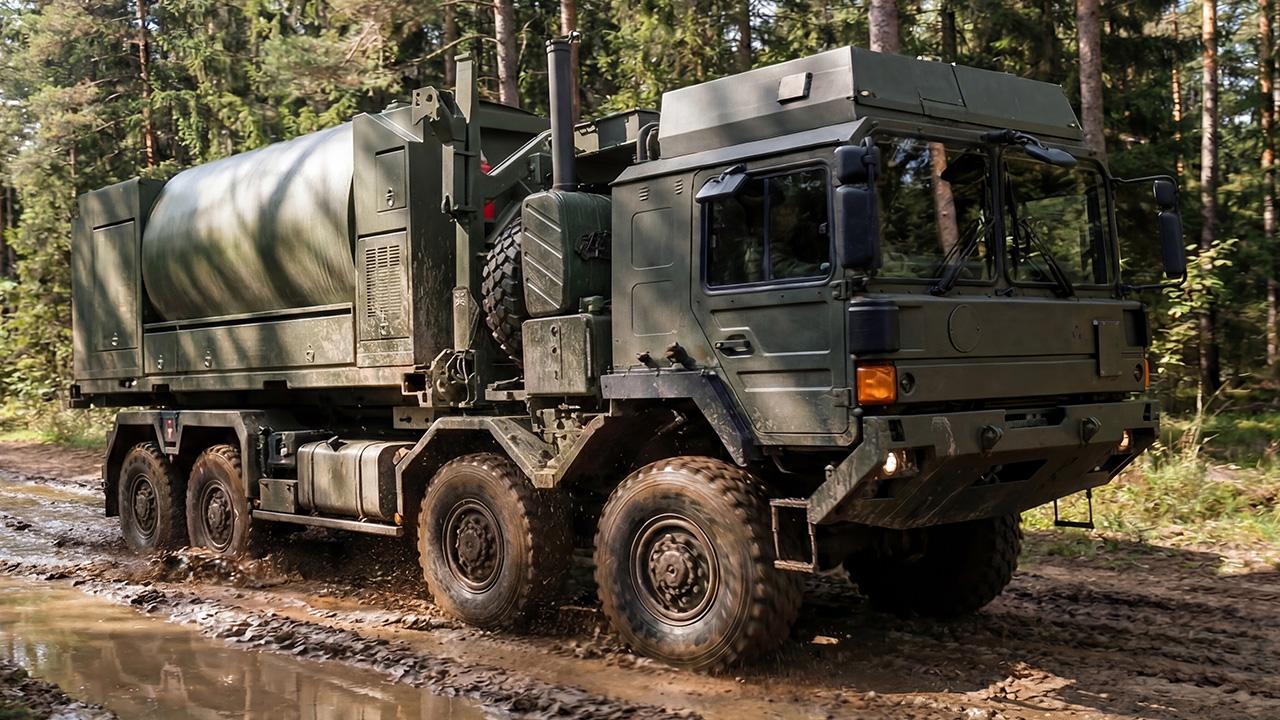

As military forces adapt to a more transparent battlefield, HMK Bilcon believes fuel logistics must be treated as an operational capability, not simply as transport or support behind the frontline.
The strongest military organisations in the world are still constrained by one unavoidable reality. Every operation depends on fuel.
“For decades, military fuel logistics has been optimised around efficiency through larger fuel sites, greater transport capacity, and centralised storage,” says Simon de Claville Christiansen, Business Development Manager at HMK Bilcon and a reserve captain in the Danish Army. “This made practical sense in environments where rear areas offered greater protection. Today, that balance is changing.”
Cheap drones, persistent ISR, and increasing battlefield transparency are exposing static infrastructure and concentrated fuel assets in ways many logistics systems were never designed for.
“Under these conditions, the challenge is no longer simply how to move fuel efficiently, but how to sustain operational tempo without creating unnecessary vulnerability across the chain.”
Flexibility and redundancy are vital
Simon believes more modular fuel concepts will become increasingly important. Using the same fuel system across multiple echelons creates standardisation in handling, maintenance, and resupply, while also introducing redundancy into the fuel chain itself.
“If one unit loses a container, another unit can replace it using the same standardised system. The loss becomes material rather than operational.”
Containerisation also changes the rhythm of fuel distribution. Fuel exchange can be separated in time and location, reducing dwell time, limiting predictable movement patterns, and keeping personnel away from exposed areas.
“The operational value is not only protection. It is freedom of action.”
Tomorrow’s fuel logistics will be different
As drone capability develops and detection ranges expand, static systems and predictable logistics patterns will become increasingly difficult to sustain.
“Future fuel logistics will need to prioritise modularity, mobility, redundancy, and interoperability across allied forces,” says Simon. “Not because these principles are ideal in theory, but because they offer greater resilience under real operational pressure.”
The organisations that adapt fastest to these conditions will gain greater operational freedom in environments where tempo, survivability, and sustainment are becoming increasingly inseparable.

This article is written by:
HMK Bilcon A/S
HMK Bilcon is a Danish manufacturer of advanced fuel logistics solutions for defence applications. We design and produce fuel trucks, tank containers and integrated distribution systems that ensure reliable fuel supply across operational environments.
Our solutions are developed to support mission readiness by enabling fast, flexible and secure fuel distribution while reducing logistical footprint and operational vulnerability. Fully compatible with NATO standards, our systems deliver interoperability across platforms and echelons.
Field-proven in demanding conditions ranging from Arctic